Journal › Game Room › Air Hockey vs Foosball: The Room-Shape Problem Nobody Talks About
Game RoomAir Hockey vs Foosball: The Room-Shape Problem Nobody Talks About
What fits in a home game room
A 7-foot air hockey table (84 inches) demands a room at least 13 feet long by 9.5 feet wide, according to room-planning guidance. That figure includes 36 inches of open space at each end for stance and mallet swing, plus 3 to 4 feet around the sides. Home tables commonly run 6 to 7 feet, while full-size competitive tables stretch to 8 feet. Six feet has become the most common length for residential buyers.
Foosball asks for a different geometry. A standard table measures roughly 56 inches long by 30 inches wide and stands 36 inches high, according to specifications. Rods extend 8 to 10 inches beyond each long side. Room guidance calls for 3 to 4 feet of playing space along those sides, where competitors stand shoulder-to-shoulder. An 8-foot-by-8-foot room can accommodate a standard table. The long sides, not the ends, are where bodies accumulate.
The mistake is measuring only the table top. On foosball, the rods add hidden width. On air hockey, the stance depth at each end is non-negotiable. A rectangular room with a short wall facing the door works for air hockey. A roughly square room with open long walls suits foosball better.
Official or regulation size
Both games carry "regulation" labels, but the evidence is thin and mostly secondary. Eight feet is the length usually called official for air hockey, though manufacturer specification sheets list models ranging from 54 by 27 inches up to 89 by 48 inches. The 8-foot claim appears in buying guides rather than published rules from a governing body.
Foosball faces the same documentation gap. The ITSF (International Table Soccer Federation) regulation dimensions are cited as 56 by 30 inches, but the original source is unclear. Home tables typically fall slightly shorter, around 54 to 56 inches in length and 29 to 30 inches in width, with rods extending the functional footprint well beyond.
For most buyers, this distinction is academic. Tournament-size air hockey at 8 feet requires a room longer than many home game spaces can provide. Regulation foosball fits more compactly but still demands that side clearance. The practical choice is between a 6- to 7-foot air hockey table or a standard home foosball table, neither of which matches competitive specifications.
Noise and power
Air hockey requires an electrical outlet and runs continuously during play. The blower motor generates white noise that fills a room whether the puck is moving or not. Conversations across the table happen at elevated volume. Foosball makes sound only when struck: the percussive crack of plastic on ball, the click of rods against bumpers, intermittent and localized.
This shapes how each game lives in a house. Air hockey dominates the acoustic space of a shared basement. Foosball can coexist with a television or conversation in the same room. One demands electrical infrastructure; the other can relocate to any level floor. The power cord is not merely a connection point but a commitment to placement.
What wears out
Air hockey tables suffer from blower hole clogging, surface scratches that affect puck glide, and mallet deterioration. The playing field is a consumable: once the laminate wears, replacement means the whole table or a costly refinish. Foosball wears at the mechanical joints—rod bearings, player-figure mounts, and bumper pads. These are replaceable with standard parts and basic tools.
The maintenance cadence differs. Air hockey needs regular surface cleaning and occasional blower service. Foosball needs periodic tightening of screws and replacement of worn men or bearings. Neither is demanding, but air hockey presents larger single-point failures while foosball degrades gradually and repairably.
Who actually plays
Air hockey is strictly two-player. The table width accommodates one body per side, and the rules do not scale. Foosball doubles naturally: four players, two per side, each controlling two rods. The social mathematics matter for a room that hosts gatherings. Air hockey creates a spectacle that others watch. Foosball invites rotation and substitution, four active participants and easy entry for bystanders.
The age range diverges accordingly. Air hockey rewards reflexes and reach; younger children struggle against adults on equal equipment. Foosball allows scale-matched play across wider age spreads, with smaller hands managing rods without disadvantage. Both work for teenagers. Neither dies at thirty.
Shared-room tradeoff with a pool table
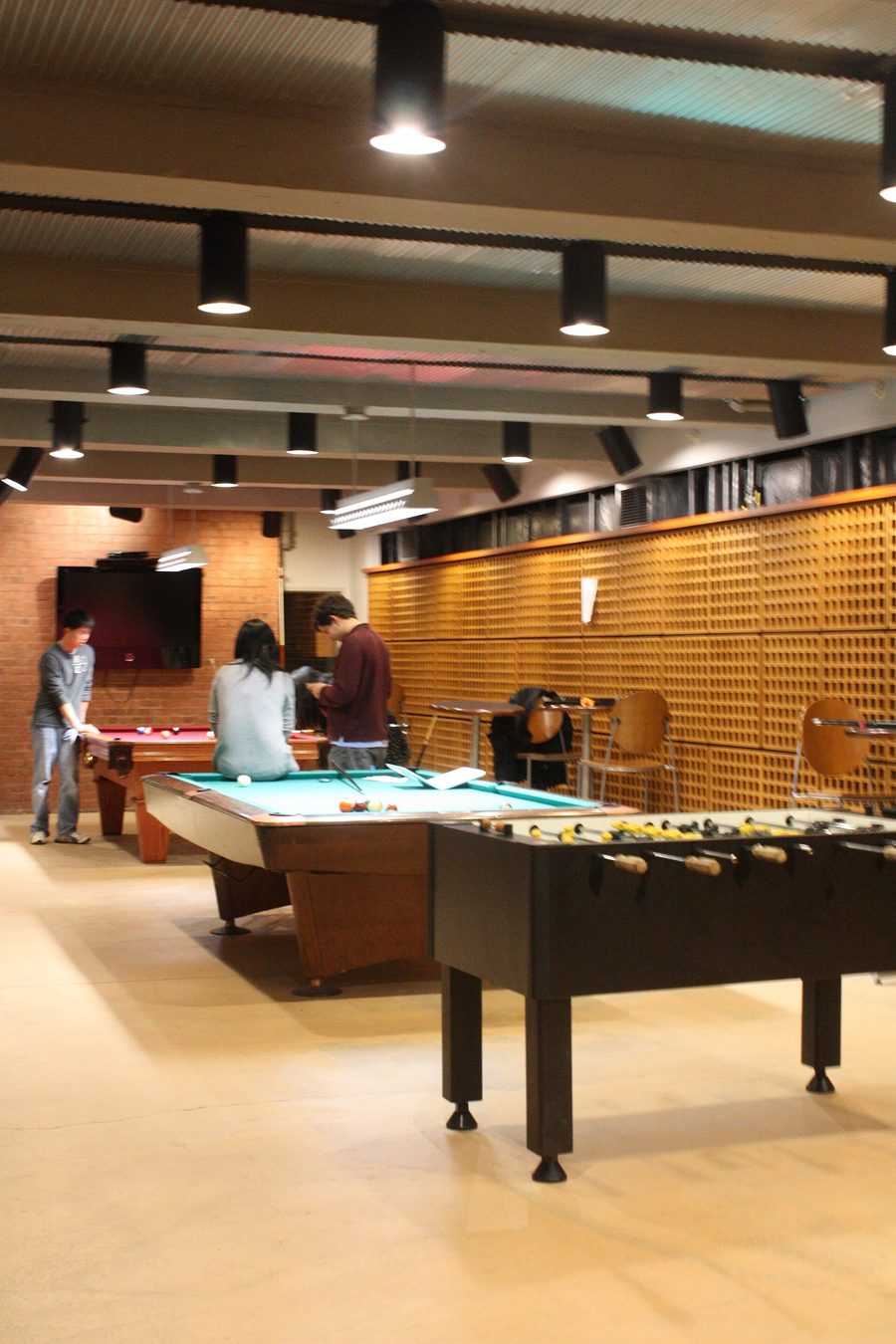
Many game rooms pair a pool table with a second option. Pool requires cue clearance on all sides—typically 5 feet from cushion nose to wall or obstacle. The remaining space is where the second table must fit. Air hockey placed behind a pool table's foot end blocks that cueing zone. Foosball placed along a side wall may preserve clearance if rods do not protrude into the cueing lane.
The practical calculation: measure your pool table's playing space, add the required clearance, then see what wall remains. Air hockey wants the far wall. Foosball wants the long wall. In a narrow rectangular room, you may have only one choice regardless of preference.
Which walls stay open
The decision is not 6 feet versus 7 feet, air hockey versus foosball as abstract categories. It is whether your room has 9.5 feet of uninterrupted width with depth at both ends, or 8 feet of open length with clearance along the sides. One game fills the room end-to-end. The other fills it side-to-side. Measure your walls before you measure your enthusiasm.