Journal › Cue Sports › Why Your 8-Ball Break Might Not Count—Even If You Sink the 8
Cue SportsWhy Your 8-Ball Break Might Not Count—Even If You Sink the 8
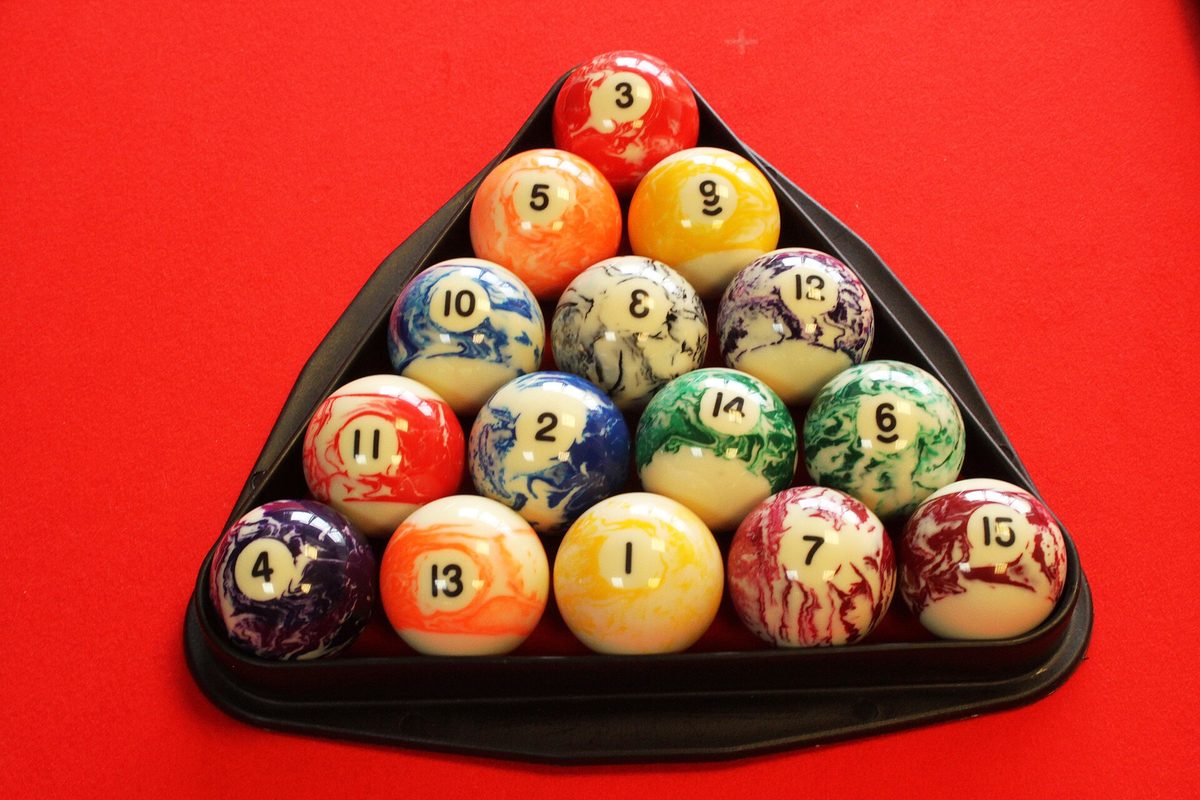
The Rack Specification
The World Pool-Billiard Association's current "Rules of Play" PDF, last updated in 2026, leaves no ambiguity about ball placement. The apex ball sits on the Foot Spot. Directly beneath it sits the 8-ball, forming the second row. The two lower corners of the triangle must each hold "one from each group of seven"—meaning one solid and one stripe occupy those corner positions, distributed so that neither group clusters.
This arrangement is not optional. The "as tightly as possible" language exists to prevent intentional gaps that could alter break patterns. Tournament referees will re-rack a loose triangle, and house players who learned from televised matches often enforce the same standard without knowing why. The geometry exists to create a fair dispersion of solids and stripes, not to favor either group.
What Makes a Break Legal
The WPA legal-break threshold has two prongs, and satisfying only one is enough. Under the rules effective since March 2016, a break is legal if the breaker pockets at least one object ball and does not foul. Alternatively, if no ball drops, at least four object balls must be driven to one or more rails. Miss both thresholds—no pocketed ball, fewer than four balls to a rail—and the break is illegal.
The consequences of an illegal break give the incoming player three explicit options: accept the table as it lies, demand a re-rack and break themselves, or re-rack and require the offending player to break again. This structure places the burden on the breaker to produce action. A soft tap that nudges three balls to cushions fails, even if nothing scratches.
Critically, the WPA rules state that when the breaker pockets a ball and does not foul, "the table remains open." This means groups have not been assigned. The breaker has merely earned the right to continue shooting, still free to choose solids or stripes based on what follows.
What Happens If the 8 Goes In
Here is where bar arguments begin. Under WPA rules, pocketing the 8-ball on a legal break shot "is not a foul." The language matters because it distinguishes between penalty and outcome. The breaker has not committed a foul, but the game does not automatically end.
The WPA treatment offers a choice. If the 8-ball is pocketed or driven off the table on the break, the breaker may request a re-rack or may have the 8-ball spotted and continue shooting. This option exists only if the break was legal—meaning the four-ball-to-rail threshold was met if nothing else dropped, and no scratch occurred.
Some interpretations published by WPA-associated sources adds a decisive wrinkle: under WPA and BCA rules, if you pocket the 8-ball on a legal break shot, you win the game immediately. This apparent contradiction with the "spot and continue" option reflects a conditional distinction. The win applies to clean legal breaks where the 8 drops without complication. The spot-and-continue remedy applies when the 8 leaves the table or when the breaker needs to continue for strategic reasons.
A document mirror of the World Standardized Rules clarifies the scratch scenario. If the breaker pockets the 8-ball but scratches on the break—sending the cue ball into a pocket or off the table—the incoming player gains control with three choices: re-rack and break, or have the 8-ball spotted and shoot with ball in hand behind the head string. The scratch converts an apparent triumph into a negotiable disadvantage.
Open Table and Scratch on the Break
The open-table rule after a legal break pocket means that sinking a solid on the break does not commit the breaker to solids. They may still choose stripes if the layout favors it. This persists until a called shot is made, establishing group ownership.
When the scratch occurs on the break without pocketing the 8, the table stays open per WPA guidance. The incoming player receives ball in hand behind the head string, may place the cue ball anywhere in that kitchen, and must shoot forward. The groups remain unclaimed. The breaker has surrendered initiative without assigning advantage.
WPA guidance on break scratches emphasizes that the foul is the scratch itself, not any pocketed object balls. Those balls stay down. The incoming player inherits a populated table with freedom of placement but restriction of direction.
Why Bar Rules Create Arguments
Most pool room disputes do not arise from ignorance of WPA rules. They arise from assumption that bar rules match WPA standards. They often do not.
Many house rules treat any 8-ball on the break as an automatic win, removing the "legal break" prerequisite entirely. Others require the 8 to be spotted and the breaker to continue, regardless of whether the break was technically legal under WPA thresholds. Still others mandate re-rack with the same breaker, or transfer break rights to the opponent, or apply handicaps based on local custom.
The World Pool-Billiard Association writes one rack: the World Standardized Rules govern sanctioned play, and house variations are not part of them. They are played anyway, in leagues and on bar tables, which is why the rack in force is worth agreeing before the first break rather than after a disputed one.
The practical consequence is that two players can execute identical breaks—legal under WPA standards, 8-ball pocketed, no scratch—and reach opposite outcomes. One wins immediately under bar rules. The other spots the 8 and continues under WPA rules, or faces a re-rack demand from an opponent invoking the illegal-break remedy if the four-ball rail threshold was not met.
Name the Rule Set Before the Break
The World Pool-Billiard Association publishes the standardized rules of play, and a match that means to be played under them should say so before the break rather than after a disputed shot.
Absent that agreement, the break that sinks the 8 produces no predictable result. The same stroke wins, draws, or resets depending on whether the table operates under September 2025 WPA standards, pre-2016 BCA variants, or the unwritten customs of the room. The argument that follows is not about what happened. It is about which rule set was in force—a question that should have been settled before the rack was tapped.