Journal › Cue Sports › Why a Pool Player Can't Just Pick Up a Snooker Cue and Win
Cue SportsWhy a Pool Player Can't Just Pick Up a Snooker Cue and Win
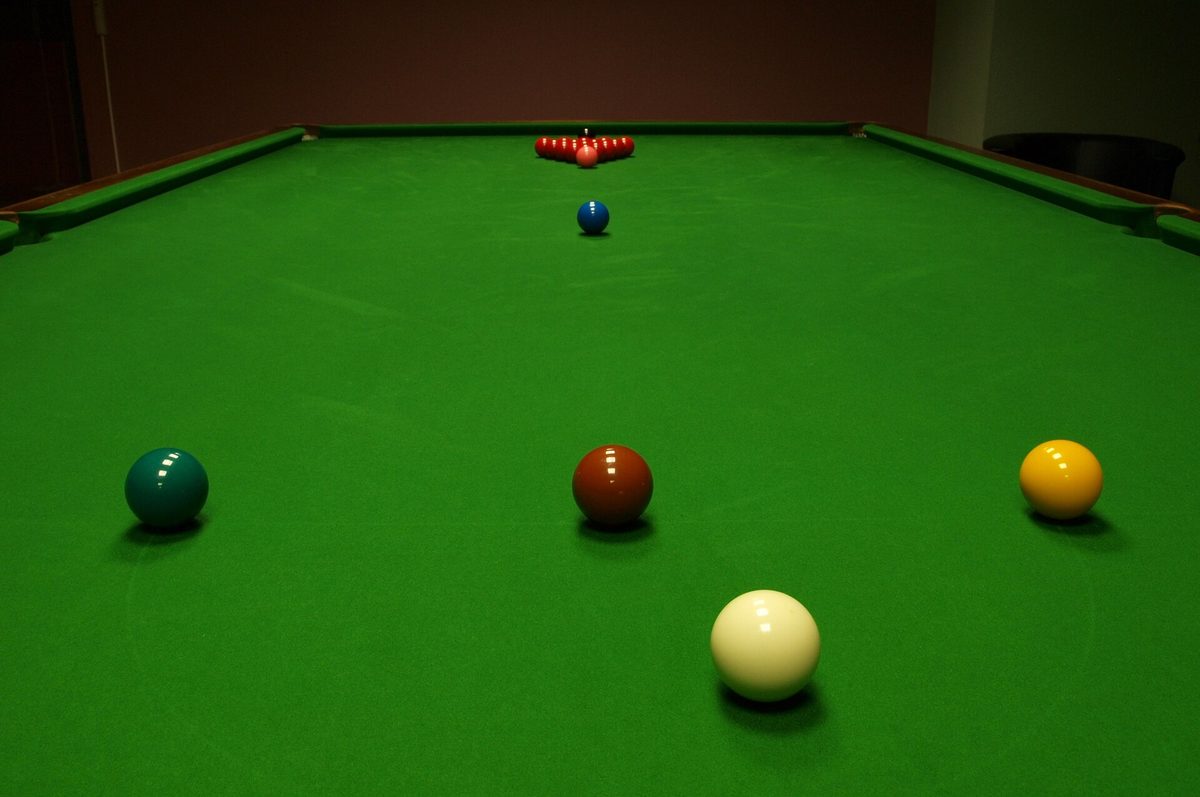
Table size and playing dimensions
The WPBSA specifies the snooker table playing area as 11 ft 8½ in by 5 ft 10 in. The World Pool-Billiard Association, which governs pool, describes the English snooker table as 12 ft by 6 ft—a nominal dimension that includes the cushions—while standard pool tables run 9 ft. The extra four feet of length and corresponding width change everything about how shots are approached. A break shot from the D at the baulk end must travel nearly twelve feet to reach a ball near the top cushion. The cue ball gathers speed over that distance, and the narrow pockets demand far tighter positional control than pool requires. A pool player accustomed to a 9-ft table will find the snooker table's proportions alien: the angles flatten, the distances stretch, and the margin for error on any shot that needs to travel more than halfway up the table shrinks dramatically.
Equipment: cues, tips, and balls
The WPBSA rules state that a snooker cue shall be not less than 3 ft in length and have a traditional tapered shape with a tip secured to the thinner end. That is a minimum, not a recommendation. Professional snooker cues typically run longer. The WPA's comparison page lists pool cues at around 58.5 inches—just under 5 ft—with tips of 12.5–13 mm. Snooker cues run longer and thinner, with tips commonly 9–10 mm. The smaller tip demands a purer strike. It offers less margin for error on off-centre hits and requires the player to deliver the cue with less lateral deviation than a pool player typically develops.
The balls differ just as sharply. The WPA lists standard pool ball diameter as 2¼ inches, or 57.15 mm. Snooker balls are smaller than pool balls. The smaller ball sits lower in the pocket, and the pocket openings on a snooker table are proportionally tighter relative to the ball size than on pool tables. The geometry matters: a ball that would rattle and drop in pool is more likely to jaw and stay on the table in snooker. The cloth, too, plays differently. Snooker tables traditionally use napped wool that runs in one direction, affecting how the cue ball rolls and how side spin takes. Pool cloth is typically worsted, flatter and faster. The difference is not merely aesthetic. A player who has learned to judge speed on pool cloth will overhit or underhit on snooker cloth until the eye recalibrates.
Scoring: reds, colours, and break-building
The WPBSA defines a pot as an object ball entering a pocket after contact with another ball and without any infringement of the rules. It defines a break as "a number of pots in successive strokes made in any one turn by the striker." In snooker, scoring is not simply about sinking balls. There are fifteen reds, each worth one point, and six colours: yellow (2), green (3), brown (4), blue (5), pink (6), black (7). After each red is potted, the player must nominate and pot a colour, which is then re-spotted on its designated spot. The sequence continues until no reds remain, then the colours must be potted in ascending order. The maximum break—potting all fifteen reds with fifteen blacks, then the colours in sequence—totals 147 points.
This structure rewards a different skill set than pool. In eight-ball or nine-ball, the objective is to clear a group or a sequence. In snooker, the player must constantly choose between scoring and safety, between taking a difficult black to continue a break and playing a defensive shot that leaves the cue ball tucked behind a colour. The break-building player must plan three, four, five shots ahead, positioning the cue ball not just for the next pot but for the next red after the colour is re-spotted. Pool players who step to a snooker table often play the shot in front of them. That habit costs frames.
Fouls, misses, and the cost of imprecision
The WPBSA rules state that a miss occurs when the cue-ball fails to first contact a ball on, or when a nominated free ball is not first hit as required. The penalty is two points added to the opponent's score. This rule, unique in its formal severity, shapes how players approach difficult positions. In pool, a failed escape attempt may leave an opening. In snooker, a miss that the referee judges not to have been a genuine attempt at the shot can be called, with the opponent then having the option to make the striker play again from the same position. The two-point penalty compounds the damage. A player who falls behind by thirty or forty points in a frame faces a structural disadvantage that can only be overcome by a substantial break—a sequence of pots in successive strokes that pool simply does not require in the same way.
The snooker itself—leaving the cue ball behind a colour so the opponent cannot see a red full-on—changes the tactical texture. In pool, defensive play exists but is less formally rewarded. In snooker, a good snooker can force an error, a miss, and a swing of four or six points that alters the frame.
The transfer problem
A pool player brings habits that do not map onto snooker. The longer cue feels unwieldy. The smaller tip magnifies technical flaws. The distances distort depth perception. The scoring system punishes the single-shot mentality. The cloth responds differently to side and screw. The pockets reject shots that would drop on a pool table. Even the stance and bridge must adjust for a table whose surface is farther from the floor and whose cushions sit higher relative to the balls.
The WPBSA publishes a single rulebook covering both snooker and English billiards. English billiards—cannon, winning hazard, losing hazard—shares the equipment and the cloth but not the scoring structure of snooker. That coexistence in the rulebook underscores how much the games diverge despite shared ancestry. A player competent at English billiards has transferable skills to snooker, but a pool player does not. The table is the wrong size, the balls the wrong weight, the cues the wrong proportion, and the strategic objectives misaligned.
The practical consequence is that a pool player who walks into a snooker club expecting to compete will struggle even against modest local players until the eye adjusts, the technique tightens, and the scoring logic rewires the approach to each shot. The table is larger. The equipment is different. The scoring rewards a precision that pool does not demand.