Journal › Cue Sports › Russian Pyramid Rules: Why Your Pool Skills Won't Help on a 12-Foot Table with Near-Pocket-Sized Balls
Cue SportsRussian Pyramid Rules: Why Your Pool Skills Won't Help on a 12-Foot Table with Near-Pocket-Sized Balls
Why the Table is the Whole Story
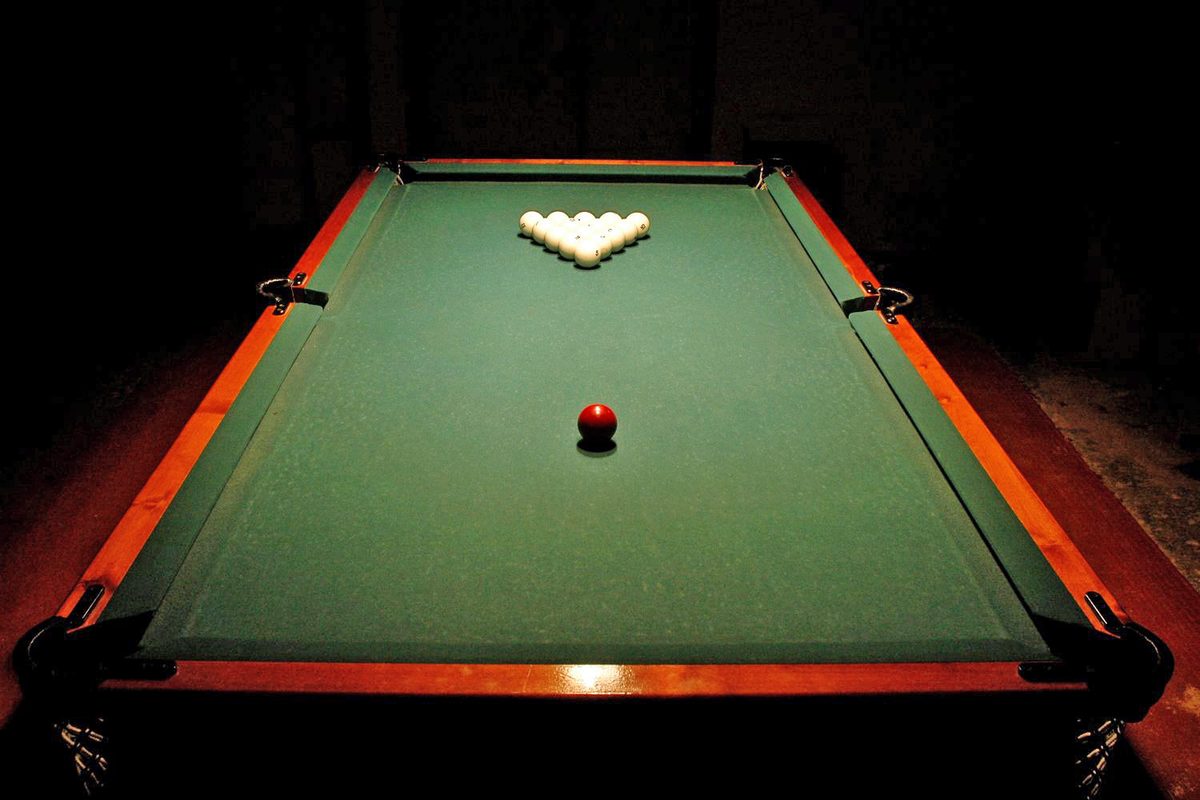
Official tournament play requires that 12-foot playing surface, though Russian pyramid can be played on smaller tables as well. The balls dwarf standard American pool balls, which measure 57.15 millimetres. The discrepancy is substantial—nearly 11 millimetres in diameter—and it fundamentally alters what shots are physically achievable.
The pocket tolerances compound the challenge. One source describes corner pockets with only about 3 millimetres of clearance, while another gives 4 to 5 millimetres. For middle pockets, estimates range from 12–13 millimetres to 14–18 millimetres. Available sources vary on pocket measurements, leaving players and equipment manufacturers working from secondary sources.
This geometry explains why the game looks impossible to trained eyes. A pool player accustomed to standard corner pockets encounters something closer to a tolerance fit than a target. The margin for error essentially disappears.
How the Game Gets Played
The most distinctive rule in Russian pyramid separates it from every major pool discipline: in free pyramid, any ball may be used as the cue ball. A player strikes one white ball with another, and the struck ball becomes the effective cue ball for that shot. This transforms the tactical landscape. Position play becomes multidirectional. Safety possibilities proliferate because the cue ball is not predetermined.
Two other variants restrict this freedom. In combined pyramid and dynamic pyramid, only one ball serves as the cue ball throughout. The Russian Federation of Billiard Sports, which governs the sport internationally, lists "Svobodnaya," "Kombinirovannaya," and "Dinamichnaya" pyramid as its three main variants. All three use fifteen unnumbered white balls, according to the federation's general rules.
The official international rules, effective 1 January 2025, represent the current governing standard. The federation maintains both Russian-language originals and English translations on its website.
The Three Main Variants
Free pyramid—"Svobodnaya piramida"—offers the purest expression of the any-ball-as-cue-ball principle. Combined pyramid adds a positional constraint: after the cue ball is pocketed, it is spotted in the baulk area, and from that position until the next stroke, balls may be pocketed only in the side and far-corner pockets. This creates a transitional phase in each rack where scoring zones shrink dynamically.
Dynamic pyramid operates differently. When the cue ball is pocketed, the scorer must remove one object ball from the table. The ball count diminishes as play progresses, accelerating the endgame and rewarding players who can clear balls efficiently while managing the shrinking table population.
All three variants share a common win condition: the first player to pocket eight balls takes the frame. This is not eight-ball pool in any recognizable sense—there are no solids or stripes, no called pockets, no defensive assignment of groups. It is a race to eight in a game where pocketing even one ball can require extraordinary precision.
What the Federation Says Now
The Russian Federation of Billiard Sports functions as the sport's international rulemaking body, a status it has consolidated through publication of the official international rules and their 2025 revision. The federation's site hosts the rules, serving as a reference for competitive play.
The organization's formal corporate status is not specified in accessible sources. Its functional authority rests on its publication and maintenance of the rulebook rather than on any documented international charter.
The 2025 rules revision reflects updates to the sport's competitive framework.
What Pool Instincts Get Wrong
A pool player stepping to a Russian pyramid table brings expectations that the equipment systematically frustrates. The cut shot—common in pool—becomes geometrically challenging. With pocket openings barely wider than the balls themselves, the effective pocketing angle shrinks to a fraction of what pool allows. A cut that would slide into a pool pocket rattles the jaws or rebounds across the table.
The carom, by contrast, gains viability. Because any ball can be the cue ball in free pyramid, and because the tight pockets reward indirect routes, players develop cue-ball control through object-ball contact rather than through cue-ball spin and speed management. Safety play becomes a key tactical mode. Aggressive shotmaking is not merely risky—it is often mathematically inferior to a well-constructed safety that leaves the opponent no legal path to a pocket.
Pool players also misread the pace. The larger balls and longer table demand recalibrated stroke mechanics. English transfers differently. The cloth—often faster than typical pool felt—extends distances that look manageable until the balls keep rolling. Position play for a specific angle becomes less relevant when the angle itself may not exist.
This Is Not Pool with Bigger Balls
The distinction matters beyond scale. Russian pyramid is not a scaled-up version of straight pool or one-pocket. It is a different sport built on different physical constraints. The fifteen white balls eliminate the informational advantage of numbered or coloured balls. The any-ball-as-cue-ball rule in free pyramid eliminates the positional predictability that governs pool safety play. The pocket tolerances eliminate the shotmaking margin that permits pool's aggressive patterns.
A pool player attempting to play pyramid as pool will struggle not because the skills are absent but because they are misapplied. The safety is not a defensive retreat but an active attacking position. The carom is not a desperation escape but a primary scoring route. The runout is not the standard of excellence but a rarity celebrated precisely because the equipment resists it.
The federation's rules recognize this reality. The three variants offer different balances of freedom and constraint, but all assume that pocketing eight balls on this equipment constitutes a genuine athletic achievement. The 2025 revision did not relax the geometry. It codified the difficulty as the sport's defining characteristic.