Journal › Table Lab › Worsted or Napped: How Cloth Changes the Game
Table LabWorsted or Napped: How Cloth Changes the Game
Why Construction Dictates Ball Behavior
Worsted pool cloth delivers speed and predictability because it has no nap. The surface is smooth, tightly woven, and nap-free, producing faster, more consistent ball roll across the bed. Napped cloth, by contrast, is built for drag. The directional texture slows the balls and gives shots a bias depending on which way they travel. This is not a minor preference. It changes how the table plays, which games suit it, and whether a refitter has chosen the right surface for the frame underneath.
Worsted cloth is nap-free by design, engineered for uniform performance. That uniformity is the point. Worsted cloth is the preferred fitment for American tables, giving low ball drag, consistency in any direction, and longer, faster shot travel. The same guide notes that napped cloths are designed for British pool tables and snooker tables, where the nap creates drag that slows the balls and gives shots direction. Two surfaces, two mechanical outcomes, and no clean way to split the difference.
What Nap Actually Does to a Rolling Ball
The nap on traditional baize is not decorative. It is a directional texture that can be felt by stroking the surface one way and then the other. That texture matters because the nap direction is fixed during installation. The nap must run from the head of the table—where the break line is—to the foot, where the balls are racked. The cloth is not reversible or rotationally symmetric. A ball rolling with the nap faces less resistance; a ball running against it fights drag that slows the shot and can tug the line off true.
This directional asymmetry shapes shot selection and speed control. Players on napped cloth learn to account for the grain, much as golfers read greens or woodworkers plane with the grain. The effect is not subtle. The same stroke that sends a ball four rails with the nap may stall it at three against. Worsted cloth removes that variable. The surface plays the same in every direction, which is why American pool—played with fast breaks and run-out patterns—migrated toward nap-free worsted while British pool and snooker stayed with napped wool.
Where Each Cloth Belongs
The fitment is not arbitrary. Worsted cloth is the fitment for American tables, while napped cloths are made for British pool and snooker tables. The distinction is structural as much as traditional. American tables typically use larger balls—2¼ inches—on wider pockets with more forgiving angles. Speed helps the game flow, and worsted cloth delivers it. British pool uses smaller balls—2 inches—on tables with tighter pockets where positional play and safety exchanges matter more; the directional drag of napped cloth adds a control layer that rewards finesse over power.
Snooker tables, with their 2⅙-inch balls and fractional pocket openings, depend on precise cue-ball regulation. The nap's drag is integral to how the game is taught and played. Installing worsted cloth on a snooker table would not merely feel different; it would break the calibrated relationship between stroke speed, distance, and side spin that the game's geometry assumes. Conversely, fitting napped cloth to an American pool table would deaden the action and introduce directional bias where none is expected. The surfaces are not interchangeable.
The Numbers on the Roll
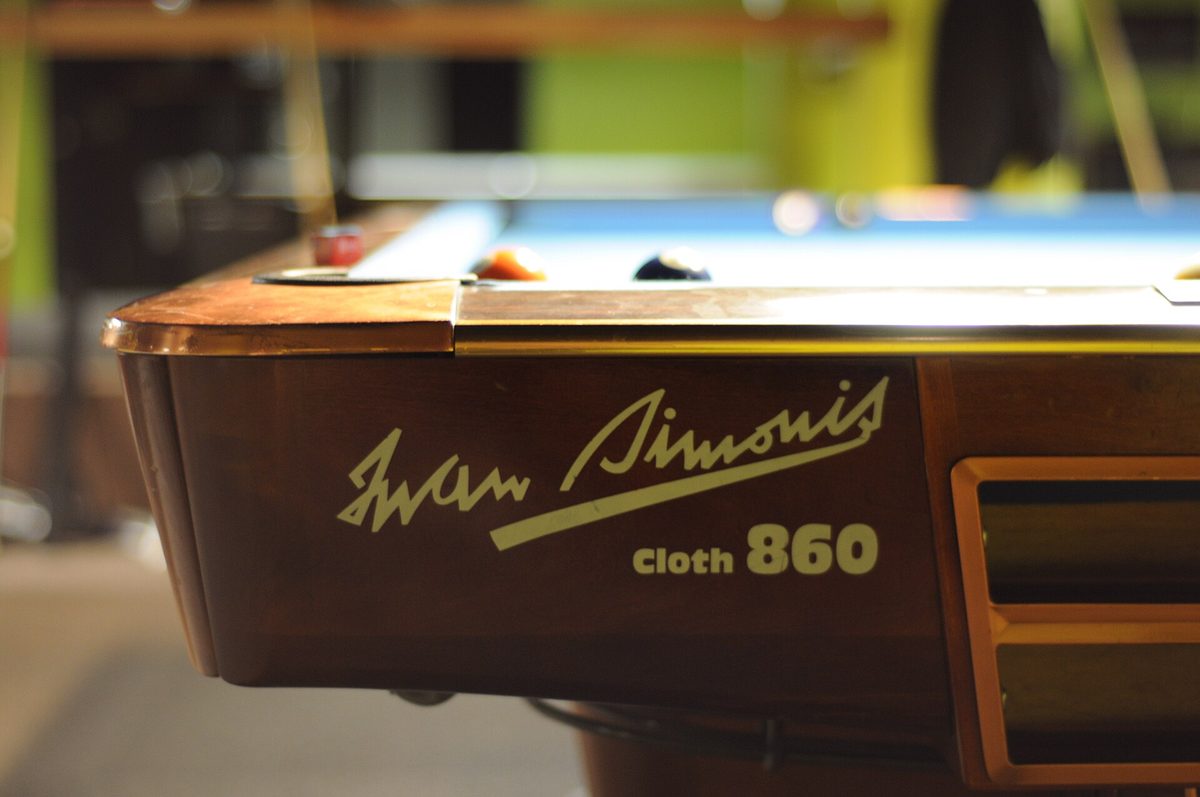
Retailers list specific figures for worsted cloth, and they vary by blend and weight. Simonis 760 is 70% wool and 30% nylon, weighing 355 g/m². The same product is sold in a 195 cm roll width. Simonis 860 shifts to 90% wool and 10% nylon, at roughly 410 g/m² with a 198 cm width. The higher wool content and heavier weight suggest a slightly slower, more controlled surface than the 760, though both remain firmly in the worsted, nap-free category.
Granito Basalt, a tournament cloth, is 80% worsted wool and 20% nylon, at 890 g per running metre. The weight unit differs—grams per running metre against grams per square metre—but the density is clearly higher than the Simonis grades. The width is 1.65 m, narrower than the Simonis rolls. These figures matter to installers calculating yardage and to players sensing the bed's response. Heavier cloths tend to wear slower and rebound with more authority; lighter cloths play faster and show wear sooner.
What the Blend Means in Practice
The wool-nylon ratio affects durability and speed for home-table buyers. Pure wool napped cloth is traditional and directional, but it wears under heavy use. Nylon adds tensile strength and speeds up the surface. Simonis 760's 30% nylon maximizes speed and longevity for American pool; Simonis 860's 10% nylon keeps more wool in the face for players who want a touch more grab. Granito Basalt's 20% nylon sits in the middle, aimed at tournament play, where consistent roll over long sessions matters more than absolute velocity.
What the sources do not provide is a standardized speed test or roll-distance measurement that would let buyers compare these cloths numerically. The claims are directional—faster, more consistent—not quantitative. Installers learn to translate weight and blend into expected behaviour, but the absence of a governing-body performance standard means players must rely on reputation and experience rather than published coefficients.
The Choice at the Workbench
A refitter recovering a table faces a binary decision that is not reversible without stripping the bed. Nap-free worsted cloth gives faster, more uniform play with no directional bias to learn. Napped cloth demands attention to grain, rewards players who work with it, and enforces the slower, more deliberate pace of British pool and snooker. The construction difference is visible under a hand—stroke the surface and feel the drag flip with direction—and it is felt in every shot. Choose the cloth that matches the table's origin and the game's demands, because the surface will enforce that choice whether the player intended it or not.